Why Anthropic’s Claude Subscription Restriction Could Be a Strategic Shot in the Foot
We saw this live in the AI Money Group: Anthropic announced that Claude subscriptions will no longer cover OpenClaw usage starting Apr 4. You can still use Claude through OpenClaw, but now it’s pay-as-you-go. This is not just a billing line item. It’s a model-control line in the sand.
🧭 What actually changed
The email was explicit: subscription credits for OpenClaw usage are now separate from baseline Claude products.
⚖️ What it protects
Anthropic is keeping value inside its own products while charging for third-party orchestration routes.
⏱ Why timing matters
Users got 24-hour notice. If your stack is built on that model assumption, that is a real operational event.
Short version from the field
From a founder lens, this feels like walled-garden logic and an ecosystem tax at the exact moment we are asking people to own their own systems.
The rules are no longer stable in one place
If you assumed “subscription = done,” this one line breaks that equation overnight.
Product economics changed, not just pricing
This is a strategic boundary: hosted AI and machine-access tools can be treated as separate lanes.
Prepared teams benefit, unprepared teams stall
Those with OpenRouter failover and model diversification keep moving. Others suddenly have blockers.
Fallback plan is no longer optional
If a single source can flip overnight, your operations should not hinge on that one source alone.
The line in the sand was always visible to me
As much as I respect Anthropic’s business model evolution, this move reveals the downside of using a provider’s subscription as your core operating budget.
Built-in convenience becomes dependency
For a lot of users, “it works under subscription” becomes “I can’t run what I was promising” the day a billing rule changes.
This is an architecture decision, not only a billing decision
The message is clear: if you want scale with tools like OpenClaw, own the stack you connect to, not just the monthly checkbox.
OpenClaw still wins where it should
This one update is not about whether OpenClaw is useful. It’s about whether your implementation can absorb change without operational panic.
What this means for AI Money Group, and for most builders
In plain English: this is a wake-up call for everyone building long-term systems.
1) If you run a workflow on one model source, you’re carrying concentration risk
Today it is Claude. Yesterday it was another model. Tomorrow it could be a different API condition. You do not need to be paranoid; you just need redundancy.
2) The “rules change tomorrow” problem is now mainstream
We saw 24-hour notice in practice. If your business operations include AI Agents, your stack design should expect that pace of change.
3) “It’s all good if you’re already diversified” is the only line that helps
It’s not about choosing one favorite model. It’s about making one favorite model not the only one your system depends on.
4) We have to teach clients to think like operators, not subscribers
Subscriptions are comfort. Infrastructure is reliability. If you confuse the two, your AI operations become expensive emotionally and financially.
My practical recommendation for this stack
Here’s what I’m actually seeing work better with groups trying to stay both reliable and fast:
Use ChatGPT as the default brain
For teams running AI every day, I recommend the $200/month ChatGPT tier as a stable default. In practice, GPT-5.3 Spark should be the first model I lean on for routine work.
Upgrade model only when needed
When the task needs more depth, more reasoning, or a harder edge, I use GPT-5.4 instead of forcing one model to do everything all day.
Keep Claude Code local
Even if we don’t let platform billing decisions drive our stack, we can still use Claude where it’s strongest: installed on the computer, then taught as a tool route inside OpenClaw.
Example local sub-agent command
That command pattern is useful for build-heavy work when OpenClaw should ask a local Claude session to do heavier file tasks.
Proof from the moment
Attached screenshot context comes directly from the update chain. I use these kinds of references to keep the framing honest and practical.
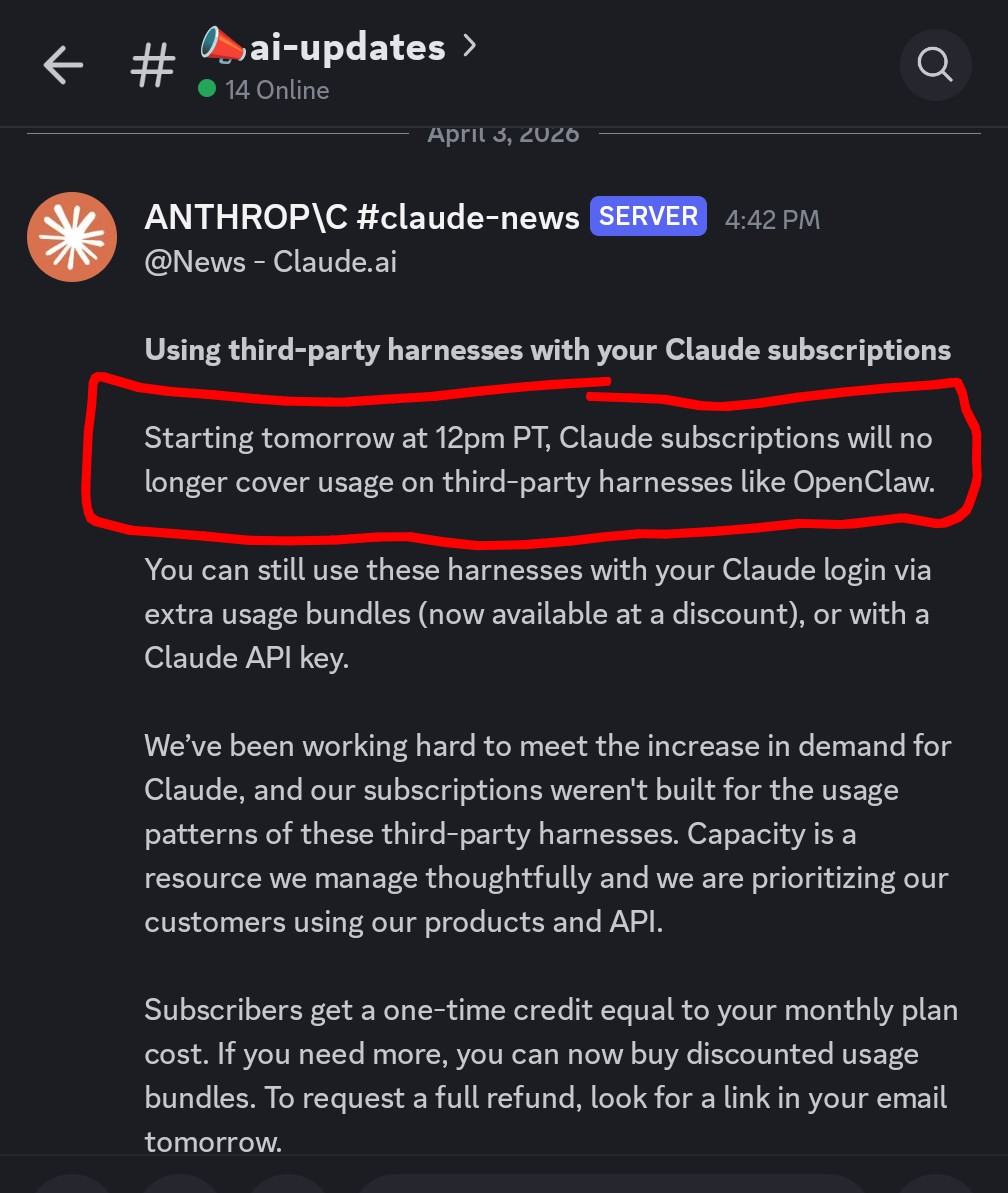
Announcement evidence
Email/notification style evidence showing the date and rule update. It’s a reminder that these changes can land quickly.
What this is a lesson about
Operationally, we should assume the platform can restrict an access path with notice and that our job is to keep the business productive anyway.
The fix is system design, not outrage.
Beau’s practical playbook (from one practical angle)
For people serious about getting consistent results with AI: build this order into your system.
Route through failover now, not later
Use OpenRouter (or equivalent orchestration) so model swaps are part of the default operating flow, not a rescue plan.
Keep one plan for “old model blocked” moments
Document exactly what flips when Model A becomes unavailable, including alert, failback, and message templates.
Own a local or hosted baseline
If your use case needs continuity, open-source models and your own server layer reduce the blast radius of vendor policy change.
This doesn’t mean “use only open source”
It means stop confusing one billing stream with your whole operating model.
What I recommend to clients immediately
- ✔ Keep one “primary” model provider for quality.
- ✔ Keep one “backup route” that runs your critical workflows on second source.
- ✔ Audit which automations are single-provider dependent.
- ✔ Build a monthly runbook for “provider interruption” drills.
What this change taught Jeff and the group
Even with strong tools, the real advantage comes from how resilient your operating process is, not how much power one model alone can claim.
In short: don’t outsource your resilience.
“Don’t build your future on a tool that can be repriced or rerouted while your business is in motion.”
That is the clean version of this page. If your stack can’t absorb a change this fast, you don’t build speed first. You build redundancy first.
Here’s the right move for most teams
The email from Anthropic may be annoying. It can also be useful, a reminder to stop treating one model provider as “the platform” and start treating your system as an actual platform.