
Teaching business owners to turn micro-offers into AI video sales systems
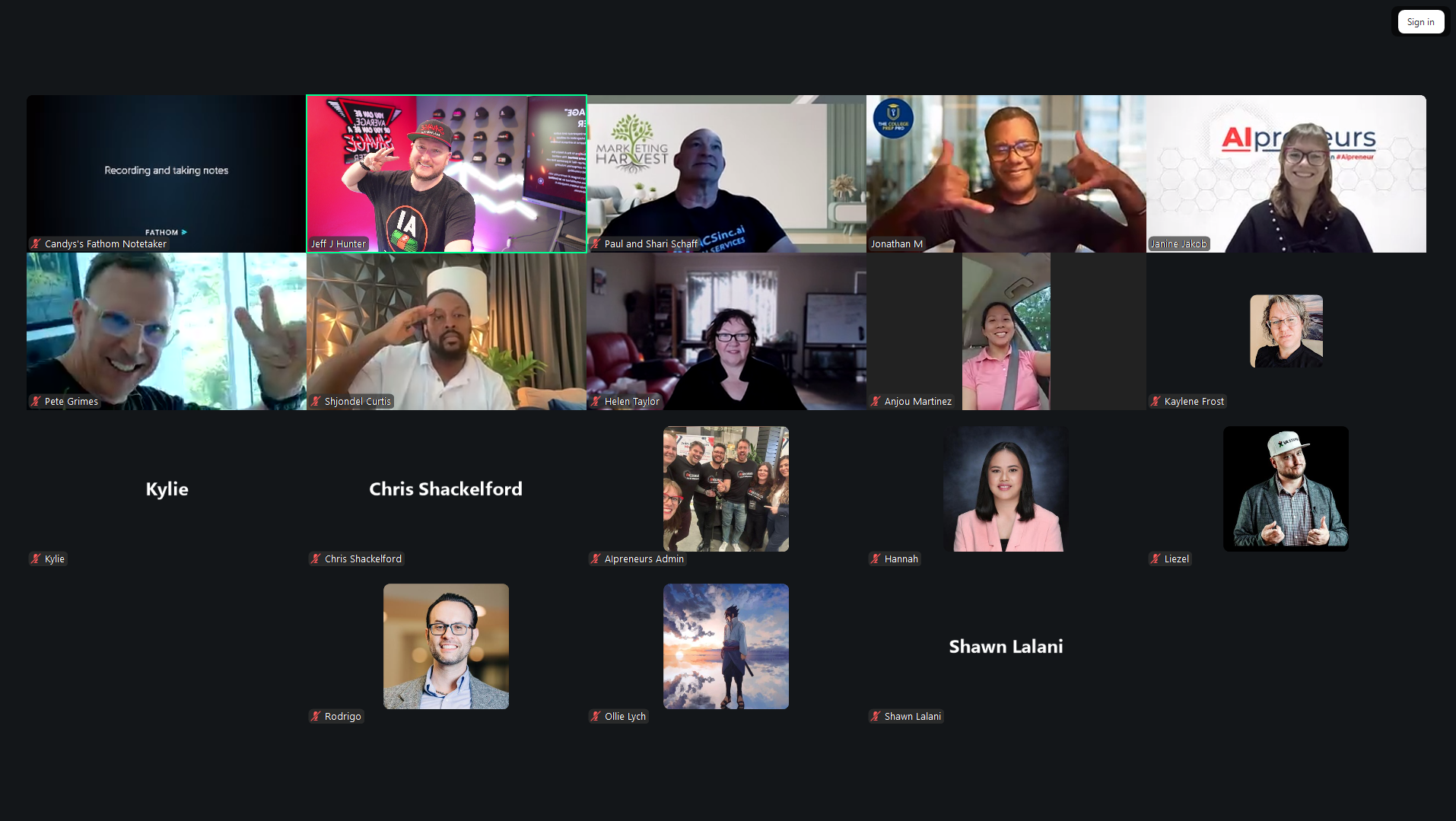
Jeff J Hunter joined the AIPreneur mastermind to show entrepreneurs how to use AI to create simple, sellable offers, then use Veo 3-style video ads to demonstrate value, attract attention, and acquire clients.
The market has moved into a “show me” economy.
The old playbook was to write a long explanation and hope the buyer imagined the value. The new playbook is simpler: show the problem, show the solution, show the result, and make the next step obvious.
That is why micro-offers and AI video fit together so well. A micro-offer solves one specific problem. A short AI-generated video can dramatize that problem, make the solution visible, and move people from curiosity to action faster.
This was not a generic AI hype session. Jeff taught the room how to think like operators: find the pain, build the small solution, create entertaining proof, then distribute the message where attention already lives.
A practical path from simple solution to client acquisition
The training centered on turning AI from a novelty into a repeatable offer creation and video marketing workflow.
Create a simple solution with AI
Use AI tools and agents to build a focused micro-offer in hours instead of weeks: a guide, prompt builder, template pack, Custom GPT, calculator, audit, or narrow implementation asset.
Package the value so it is easy to buy
A strong micro-offer has a clear audience, a painful problem, a believable promise, and a low-friction next step. No bloated funnel required.
Generate video ads that show the problem
Veo 3-style videos can create characters, scenes, comedy setups, and scenarios that make the pain point obvious without hiring actors or booking a studio.
Turn entertainment into education
The best videos do more than get attention. They make the viewer understand the problem, recognize themselves in it, and see why the micro-offer is the next logical move.
Distribute, watch, and scale what works
Publish across short-form platforms, boost the winners, retarget viewers, and refine the offer based on real response instead of guessing in private.
Micro-offers give business owners a faster way to test the market
Instead of building a huge product before knowing if anyone wants it, owners can create a focused offer, demonstrate it with video, and let real audience behavior guide the next move.
Lower buying friction
A small specific offer feels easier to say yes to than a giant vague promise.
Better video fit
Short-form video works best when the problem and payoff are simple enough to understand quickly.
Faster iteration
When the offer is compact, the market feedback loop gets much shorter.
Micro-offer ideas business owners can actually use
The point is not to create another complicated course. It is to create small solutions people can understand, buy, and use.
For marketers and consultants
- Lead magnet idea generators
- Sales email templates
- Referral request templates
- Upsell sequence frameworks
- Objection-handling scripts
- Case study outlines
For content and service businesses
- Viral video hook databases
- Story-to-sale frameworks
- Call-to-action templates
- Sales call scripts
- Testimonial request templates
- Conversion funnel maps
This is where an AI Employee becomes more than a chatbot
Jeff used the training to make an important distinction: most people use AI like a calculator. He hires AI into roles.
Offer strategist
Research the audience, map the pain, name the offer, and create the first version of the promise.
Asset builder
Draft the guide, prompt builder, landing page, checkout copy, email sequence, and distribution plan.
Marketing operator
Turn the offer into video angles, hooks, storyboards, scripts, captions, and next-step campaigns.
The comedy video sales formula Jeff taught
The training framed AI video as a way to make selling feel more like demonstration and less like begging for attention.
1. The setup
Show a relatable business problem the audience instantly recognizes.
2. The struggle
Exaggerate the pain point through comedy, tension, or a vivid scenario.
3. The solution
Introduce the micro-offer as the simple hero that solves the problem.
4. The result
Show the transformation, relief, or speed the buyer wants.
5. The CTA
Point viewers to the offer while the value is still fresh in their mind.
6. The system
Repeat, distribute, identify winners, and scale what gets real response.
Want an AI Employee that can help build offers like this?
Micro-offers are not just about clever prompts. They require strategy, packaging, assets, distribution, and iteration. That is exactly where an AI Employee can help a founder move faster without losing the human judgment that keeps the offer credible.
Educational note: video performance and sales results depend on offer quality, audience, distribution, creative, follow-up, and execution. This page summarizes the training framework; it does not guarantee specific results.