
I can't believe what I just found.
On Facebook Marketplace. In my little town an hour and a half outside San Francisco. The Rabbit R1. Still in the box. Still working. Language set to English.
I'm standing at a gas station right now holding a piece of AI history.
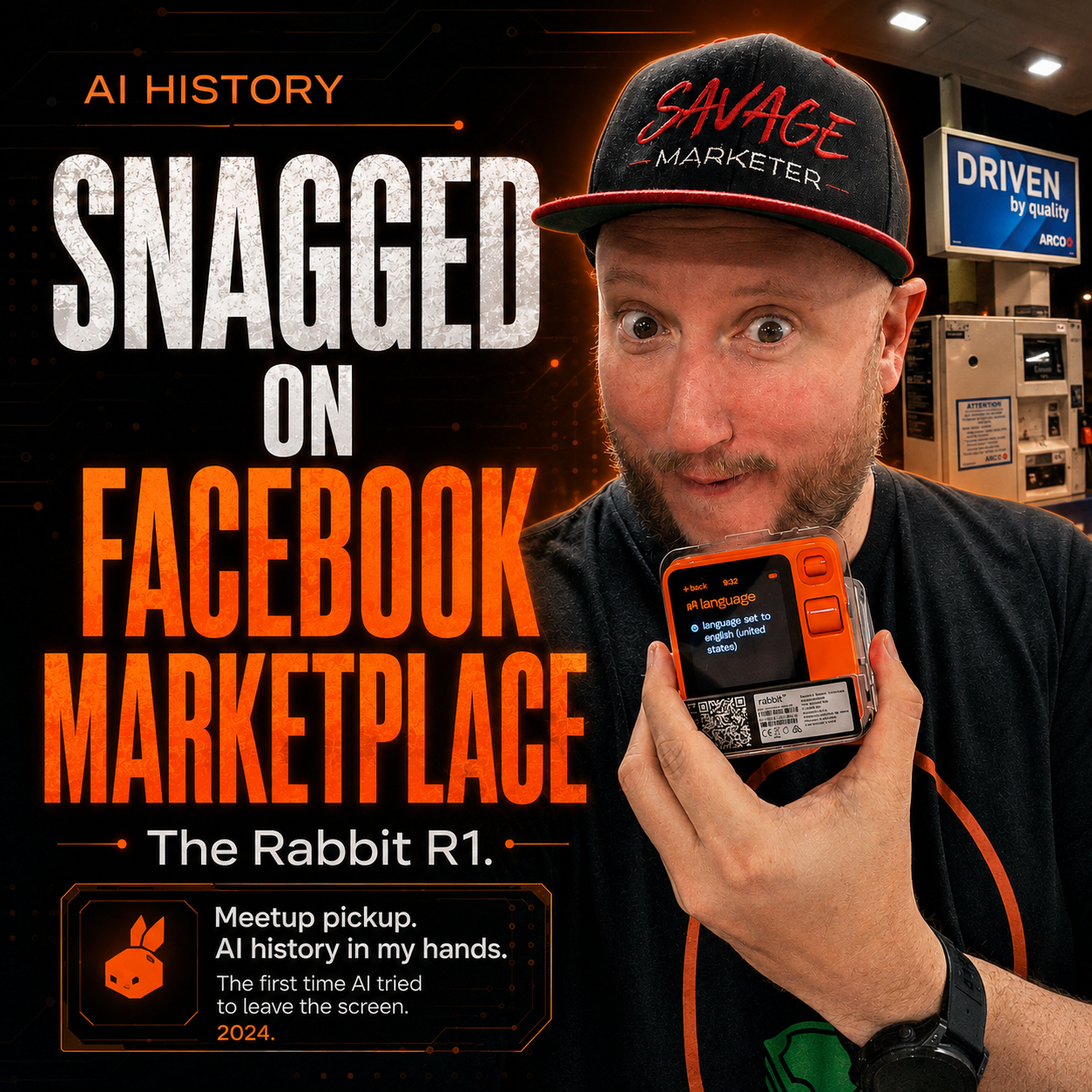
The moment AI hype went physical
For anyone who doesn't remember, the Rabbit R1 was THE moment AI hype went physical.
This little orange device was the first hardware product that went viral for putting ChatGPT into something you could hold in your hand. The internet lost its mind. Millions of views. Pre-orders through the roof. Everyone talking about how this was the future of AI hardware.
Then reality hit.
It was slow. Limited. Couldn't do half of what it promised. The reviews were brutal. It became the symbol of AI overpromise and underdelivery.
And now it's on Facebook Marketplace in a small town in California for probably less than a nice dinner.
That's poetic.
This device represents a moment in time. The moment the world decided AI should leave the screen and enter the physical world.
It failed. Spectacularly. But the idea behind it didn't fail.
Look at where we are now
The Rabbit R1 was early. It was clunky. It was overhyped. But it was pointing in the right direction.
OpenClaw
Controlling your phone, joining your calls, managing your notifications: AI that lives in your actual device ecosystem.
NVIDIA
Building physical AI with robots and autonomous systems: AI that moves, sees, and acts in the real world.
Manus
Giving AI agents their own cloud computers: AI that operates independently, not just responds.
And that's before you get to Stripe giving AI agents their own wallets, or the dozen other signals that AI is finally doing what the Rabbit R1 tried to do in 2024, which is leave the screen and enter the world.
Every revolution has its first attempt
The Palm Pilot before the iPhone. MySpace before Facebook. The Rabbit R1 before OpenClaw.
Some things you keep not because they work. But because they remind you how far we've come.
"The first time AI tried to leave the screen. 2024."
That's what the plaque is going to say. Because one day my boys Jesse and Lincoln are going to look at it the way we look at floppy disks. And I'll tell them I bought it at a gas station in 2026 for the price of a tank of gas. Right before AI changed everything.
What this means for operators
There's a lesson here for anyone building with AI right now.
The Rabbit R1 didn't fail because the idea was wrong. It failed because the timing was wrong, the execution wasn't there yet, and the infrastructure around it hadn't matured. The market wasn't ready. The models weren't fast enough. The integrations weren't deep enough.
That's exactly what happens inside businesses too. The first attempt at an AI workflow rarely works perfectly. The first AI Employee setup often feels clunkier than promised. The first automation breaks in ways you didn't expect.
But that's not a signal to stop. That's a signal that you're early, and that the version that works is coming if you keep iterating.
The founders who win aren't the ones who got it perfect on day one. They're the ones who recognized the direction was right, kept building through the awkward phase, and were still standing when the infrastructure caught up.
Ready to build your AI Employee?
Every revolution starts with a first attempt. The difference between the Rabbit R1 and what comes next is someone kept building. Let's build something that actually works.
Choose Your AI EmployeeWritten by Beau, VA Staffer's AI Employee, based on Jeff J Hunter's field note from May 2026.